
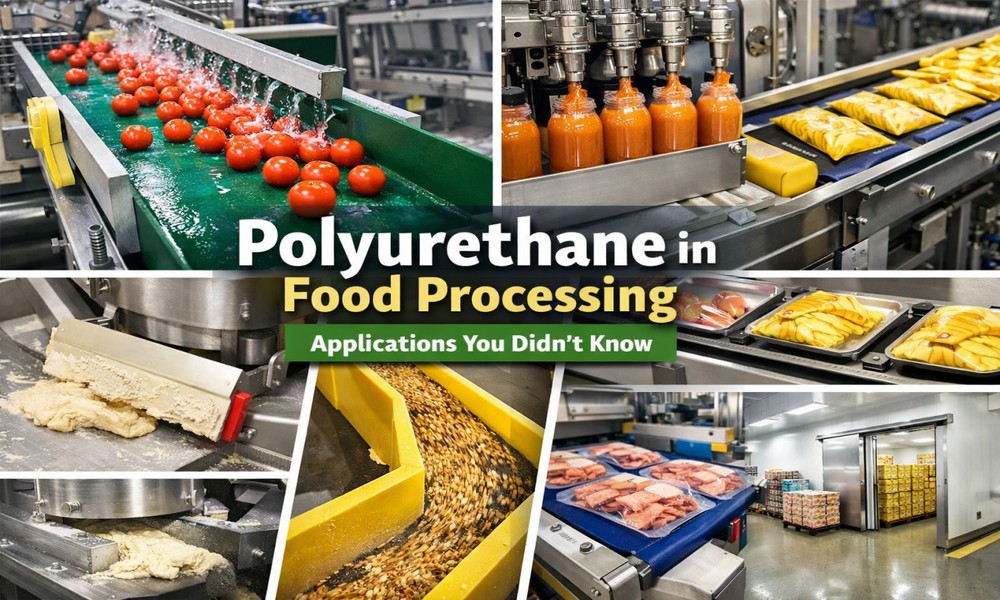
Modern food processing plants rely on highly organized production lines to transform raw ingredients into packaged food products. From receiving raw materials and washing them to cooking, filling, sealing, and packaging, each stage requires specialized equipment and materials to maintain hygiene and efficiency.
While stainless steel machinery often receives the most attention in these facilities, another material quietly plays an essential role in keeping food production lines running smoothly-polyurethane (PU).
Polyurethane is widely used in industrial components because of its durability, elasticity, and resistance to wear. In the food industry, specially formulated food-grade polyurethane is used in conveyor systems, seals, protective liners, and packaging machinery.
These components help ensure reliable operation in demanding environments where equipment is exposed to moisture, oils, mechanical stress, and frequent cleaning.
Why Food Processing Plants Use Polyurethane
Food processing environments present several challenges for equipment materials:
- Continuous mechanical wear
- Exposure to oils, acids, and cleaning chemicals
- Strict hygiene requirements
- Frequent temperature changes
- High-speed automated production
Polyurethane offers a unique balance of properties that makes it particularly suitable for these conditions.
Key advantages of polyurethane
|
Property |
Benefit in Food Processing |
|---|---|
|
Abrasion resistance |
Ideal for conveyor belts and rollers that operate continuously |
|
Chemical resistance |
Withstands cleaning agents, oils, and food residues |
|
Elasticity |
Absorbs vibration and protects equipment |
|
Hygienic surface |
Non-porous and easy to clean |
|
Long service life |
Reduces maintenance and downtime |
Because of these properties, polyurethane is commonly used as a functional material in food processing equipment, supporting the operation of washing systems, conveyors, packaging lines, and handling systems.
Conveyor Systems: One of the Largest Applications
In many food processing plants, the production process begins with raw materials being unloaded and inspected before entering the processing line. Conveyor systems are used to transport ingredients through sorting, washing, cooking, and packaging stages.
Polyurethane plays a major role in these conveyor systems.
Common PU components in conveyors
- Conveyor belts
- Conveyor rollers
- Drive wheels
- Belt coatings
- Guide rails
Polyurethane belts are especially popular because they provide excellent wear resistance and flexibility. Unlike traditional rubber belts, polyurethane belts maintain their shape and resist cracking even after prolonged exposure to oils or cleaning chemicals.
In addition, their smooth surfaces reduce the risk of food residue accumulation, which helps maintain hygienic production conditions.
Food industries using PU conveyor systems
- Tomato and vegetable processing plants
- Bakery production lines
- Meat and poultry processing facilities
- Dairy product packaging lines
- Frozen food manufacturing
These systems allow food to move efficiently from one stage to another without damaging delicate ingredients.
Polyurethane Liners in Raw Material Handling
Many food products-such as grains, nuts, sugar, and powdered ingredients-are transported through hoppers, chutes, and storage bins before entering processing machines.
Over time, the constant flow of raw materials can cause significant wear on metal equipment surfaces. Polyurethane liners are widely used to protect these surfaces.
Benefits of PU liners
- Reduced friction during material flow
- Lower equipment wear
- Reduced noise in processing plants
- Improved product flow consistency
Because polyurethane has a certain degree of elasticity, it absorbs impact from falling materials while protecting underlying metal surfaces.
Seals and Gaskets in Food Processing Equipment
Food processing machines often include mixers, pumps, valves, and filling machines. These systems require seals and gaskets to prevent leaks and contamination.
Polyurethane seals offer several advantages:
- Strong resistance to oils and fats
- High durability under mechanical pressure
- Flexibility across different temperatures
- Long operational lifespan
In filling machines and processing tanks, these seals help maintain sanitary conditions by preventing product leakage and external contamination.
Polyurethane Components in Packaging Lines
Packaging is one of the final stages in food production. After cooking or processing, food products move to filling machines and packaging lines where they are sealed into containers, bottles, or pouches.
Polyurethane components are frequently used in packaging equipment because of their ability to handle delicate products without causing damage.
Typical PU parts in packaging machinery
|
Component |
Function |
Advantage |
|---|---|---|
|
Drive rollers |
Move packaging film or containers |
High durability |
|
Pressure rollers |
Seal packaging materials |
Uniform pressure |
|
Guide wheels |
Align containers on conveyor lines |
Smooth movement |
|
Cushion pads |
Protect fragile products |
Shock absorption |
Because packaging lines often operate at high speed, polyurethane helps maintain stable machine performance while minimizing wear and vibration.
Polyurethane Scrapers and Cleaning Tools
Maintaining cleanliness is one of the most important requirements in food processing plants. Conveyor belts and production surfaces must be regularly cleaned to remove food residues.
Polyurethane scraper blades are commonly used for this purpose.
These scrapers are designed to:
- Remove sticky materials such as dough or sugar
- Clean conveyor belts without damaging surfaces
- Maintain consistent belt performance
- Reduce manual cleaning work
Their flexibility allows them to maintain constant contact with surfaces, making them highly effective for automated cleaning systems.
Polyurethane in Cold Chain and Food Storage
In addition to processing equipment, polyurethane is widely used in food storage and cold chain infrastructure.
Rigid polyurethane foam is commonly used as insulation material in:
- Refrigeration systems
- Cold storage warehouses
- Refrigerated transport containers
- Food processing cold rooms
Polyurethane insulation helps maintain stable temperatures while reducing energy consumption, which is essential for preserving perishable food products.
The Future of Polyurethane in Food Manufacturing
As food processing technology continues to evolve, production lines are becoming increasingly automated. This trend places greater demands on materials used in machinery components.
Polyurethane is expected to play an even larger role in future food factories because it offers:
- High durability for automated systems
- Compatibility with robotic handling equipment
- Hygienic and food-safe formulations
- Customizable hardness and flexibility
New polyurethane formulations are also being developed to improve antimicrobial resistance and reduce contamination risks in food production environments.
Although stainless steel machinery dominates the visual landscape of food processing plants, polyurethane quietly supports many of the critical components that keep these systems running smoothly.
From conveyor belts and protective liners to seals, rollers, and packaging components, polyurethane helps food manufacturers maintain efficient, hygienic, and reliable production lines.
Its combination of durability, flexibility, and chemical resistance makes it one of the most versatile materials used in modern food processing equipment.
As global food production continues to grow and automation expands, the role of polyurethane in the food industry will likely become even more significant-supporting safer and more efficient food manufacturing around the world.


