
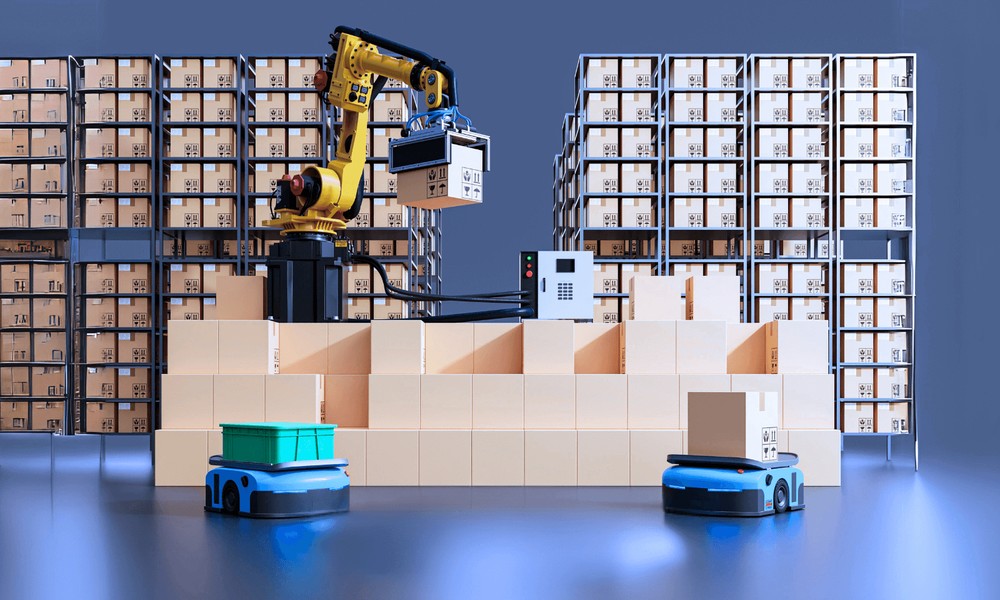
In modern food processing facilities, palletizing plays a critical role in ensuring products are efficiently prepared for storage, transport, and distribution. As production volumes increase and labor dynamics shift, many food manufacturers are re-evaluating traditional manual palletizing methods and considering automated alternatives such as column palletizers. Making the best operational investment requires an understanding of the distinctions between these two strategies.
What Is Traditional Manual Palletizing?
Traditional manual palletizing relies on human workers to stack cartons, bags, or containers onto pallets in a predefined pattern. This method has long been used in food plants due to its simplicity and low initial cost. Workers manually lift, position, and arrange products, often performing repetitive motions over long shifts.
While manual palletizing offers flexibility-especially for operations with frequent product changes or low production volumes-it comes with several limitations. Labor-intensive processes can lead to worker fatigue, increased risk of injury, and inconsistent stacking quality. Additionally, as food plants scale up production, maintaining efficiency with manual labor becomes increasingly challenging.
What Is a Column Palletizer?
A column palletizer is an automated system specifically designed to arrange products by utilizing a vertical column structure along with mechanical handling components. It integrates conveyors, lifting mechanisms, and programmable controls, and can also work as part of a broader loading and unloading system in automated food production lines.
Column palletizers are particularly well-suited for food plants that handle uniform packaging, such as cartons, cases, or shrink-wrapped goods. They can be seamlessly integrated into existing production lines and often work in coordination with upstream and downstream equipment, including a loading conveyor and an unloading system that transfers completed pallets to storage or shipping areas.
Efficiency and Throughput
One of the most significant advantages of a column palletizer is its ability to dramatically improve throughput. These automated systems are capable of operating continuously with minimal downtime, ensuring uniform speeds regardless of shift lengths or workforce availability. In contrast, manual palletizing is limited by human endurance and can slow down during long shifts or peak production periods.
For high-volume food plants, this difference translates into higher productivity and more predictable output. A column palletizer ensures that palletizing keeps pace with upstream processes such as filling, sealing, and packaging.
Labor and Operational Costs
Labor is a major cost factor in manual palletizing. Hiring, training, and retaining workers-especially for physically demanding tasks-can be both expensive and challenging.
Furthermore, repetitive lifting-related job accidents may result in higher insurance premiums and decreased productivity.
By automating palletizing tasks, column palletizers significantly reduce reliance on manual labor.
Even though the initial outlay is more, the long-term labor cost reductions and decreased risk of harm frequently outweigh the cost.
Consistency and Product Safety
In the food business, cleanliness and uniformity are essential. Uneven stacking from manual palletizing may jeopardize pallet stability while being transported. This raises the likelihood of product damage and safety concerns.
Column palletizers, on the other hand, use programmable logic to ensure precise stacking patterns every time. Pallet stability, product damage, and supply chain dependability are all improved by this consistency. Moreover, automated systems minimize direct human contact with packaged food products, supporting higher hygiene standards.
Flexibility and Adaptability
Due to its flexibility, manual palletizing allows workers to swiftly accommodate changes in product dimensions, packaging formats, or pallet arrangements. This is especially advantageous for smaller-scale operations or those dealing with frequent product fluctuations.
Modern column palletizers, however, have become increasingly adaptable. With advanced control systems and quick-change tooling, they can handle multiple product types and pallet patterns with minimal downtime. Although they may not match the instant adaptability of human workers, they offer sufficient flexibility for most medium- to large-scale food operations.
Space and Integration
Space utilization is another important consideration. Manual palletizing typically requires larger floor areas to accommodate workers and staging zones. In contrast, column palletizers are designed to be compact and can be integrated vertically, making efficient use of available space.
Additionally, automated systems can be connected to a broader unloading system, enabling smooth pallet transfer to warehouses or automated storage solutions. This level of integration supports streamlined operations and reduces bottlenecks.
Conclusion
Choosing between a column palletizer and traditional manual palletizing depends on several factors, including production volume, labor availability, budget, and operational goals. While manual palletizing remains a viable option for smaller or highly variable operations, it struggles to meet the demands of high-volume, efficiency-driven food plants.
Column palletizers offer a compelling alternative by delivering higher throughput, improved consistency, enhanced safety, and long-term cost savings. As automation continues to reshape the food industry, more manufacturers are recognizing the value of transitioning from manual processes to advanced palletizing solutions that support scalable and sustainable growth.